








Sliding doors
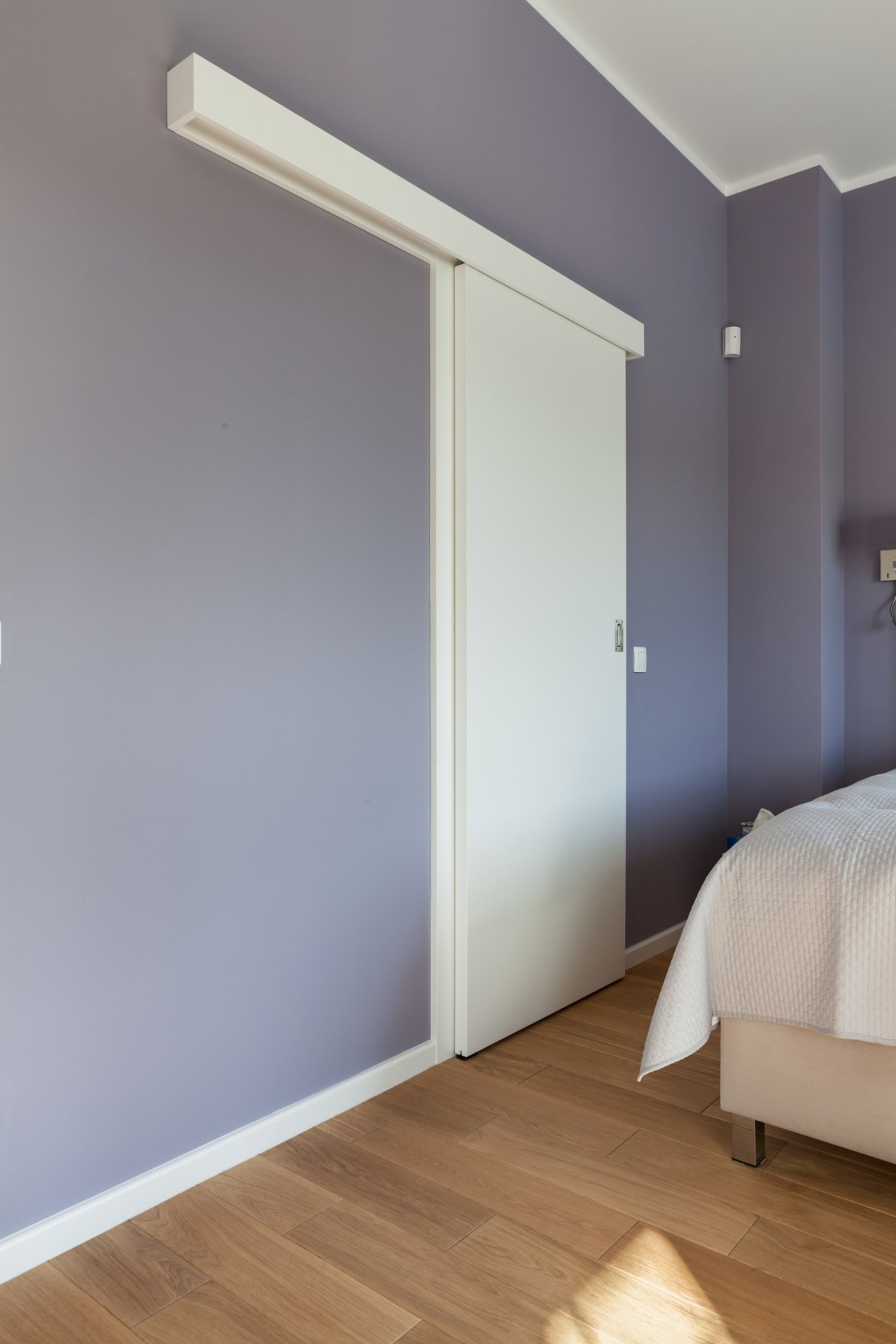
Solutions that allow us to use space in a completely different way than with traditional doors. Their main advantage is that they can be much wider than traditional doors. If we use a width of, for example, 100 centimeters or more, traditional doors would take up too much space. Sliding doors also allow us to expand the space. Imagine using a door from floor to ceiling. When opened, we have an opening between, for example, the living room and the kitchen, or a connection between two smaller rooms. Sliding doors are very often installed in small rooms where traditionally hinged doors would take up too much space, as well as in large rooms where we care about special interior design.
Wall-mounted sliding doors
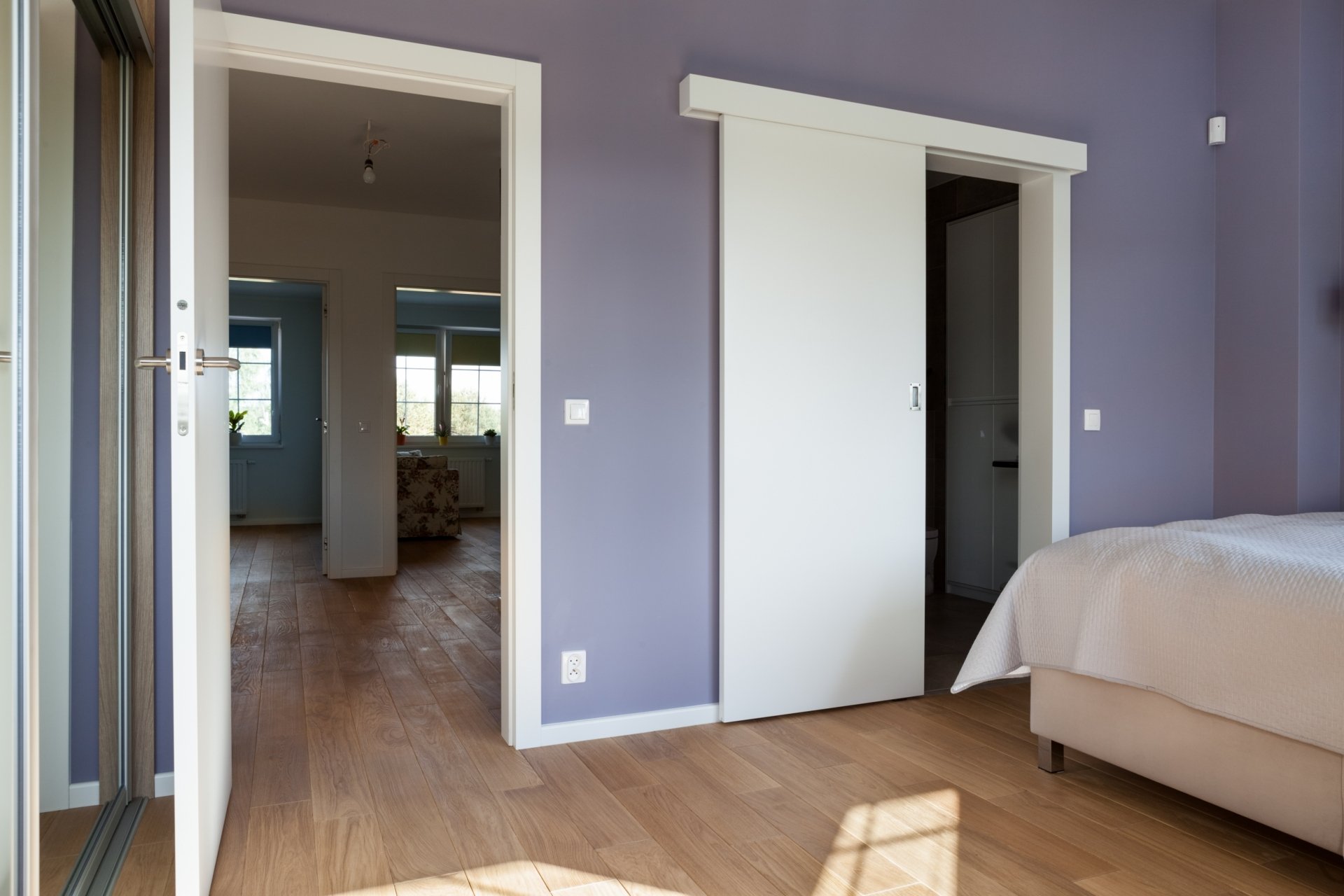
We can install this type of door almost always, even after constructing partition walls. The door opening should be the size of the door leaf, with the same size space on the wall where the door will slide. Wall-mounted sliding doors are installed on a track, which is mounted above the door opening or on the ceiling. The doors slide on wheels along the installed track.
The width of such doors can range from 60 to 150 cm. Everything depends on the size of the door opening and the type of handle we want to use. If we place the handle on the plane of the door leaf, it must be at least 10 cm wider than the door opening. A handle mounted on the edge of the door leaf allows for the use of a door width equal to the planned opening.
Single or double leaf?
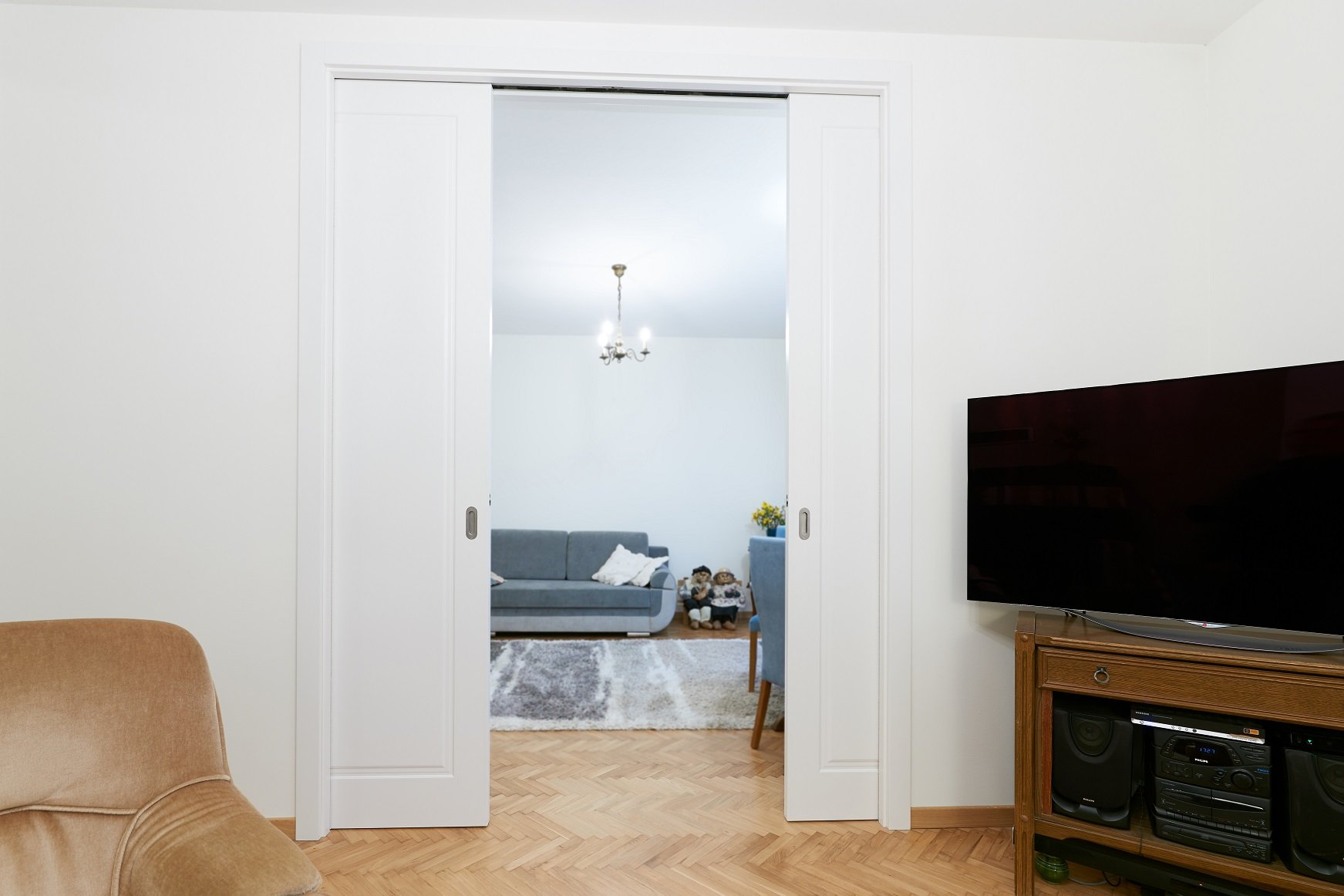
Wall-mounted sliding doors can be either single-leaf or double-leaf. Single-leaf doors open on one side. Double-leaf doors can slide on two sides if space allows. They can also open telescopically on one side. In this case, a two-track guide should be installed. One leaf will hide behind the other.
The main advantage of such doors is, of course, the price and ease of installation. They can be installed in already constructed apartments. Their installation does not require any masonry or construction work, nor does it interfere with the structure of the walls.
A definite disadvantage is that they are always visible. On the wall to which they slide, you cannot hang pictures or place furniture. Additionally, this type of sliding doors poorly insulate sounds. There will always be a few millimeters gap between them and the wall, which means that soundproofing will not be as good as with sliding doors mounted in the wall, in a cassette.
It is best to plan this type of door in advance - during the construction stage. Alternatively, when partition walls have not yet been erected. Such doors are installed in ready-made systems equipped with rails and carriages. These systems are already adapted to typical doors and wall types.
However, if the partition walls are already in place, there is nothing to prevent the installation of concealed sliding doors in the wall. In this case, the door with a cassette should be covered with an additional wall made of plasterboard. It is worth using two plates, then the structure will be more stable and the soundproofing much better. You can also overlay the door cassette on the wall and cover it with a protective wall. This is more expensive, but the construction is much more stable and durable. If we build a wall only the width of the door, then there will be a step of about 10 centimeters. However, we can build a wall along the entire length of the wall to achieve a uniform surface. A drawback of this solution is certainly the reduction of the room by those 10 centimeters. The rules for mounting handles are similar to those for wall-mounted doors.
Single-leaf doors use cassettes that are 60, 70, 80, 90, and 100 centimeters wide. The double-leaf door system consists of two cassettes connected by a rail. Each cassette has the width of one leaf. When using double-leaf doors, a synchronous opening system can be installed. While sliding one leaf, the other leaf is simultaneously opened.
The main advantage is aesthetics. Doors hidden in the wall are invisible. Even those covered with a wall made of plasterboard provide a similar effect. You can hang pictures on such a wall, place furniture next to it. It is a fully functional wall in a room. The interior is well soundproofed.
The disadvantages are undoubtedly the visible step or the reduction of the room by about 10 centimeters. And of course, these solutions are more expensive than with wall-mounted sliding doors.